
We launched this petition just over a month ago and have so far gathered more than 1,000 signatures—but we’re looking to get 1000 more! Please share this with people in your community!
One of the main goals of our petition is to inform folks about what’s been happening at the City of Bellingham’s waste water treatment plant at Post Point. Since the launch of the petition we have had so many great conversations with community members—thank you for being curious, concerned, and asking challenging questions.
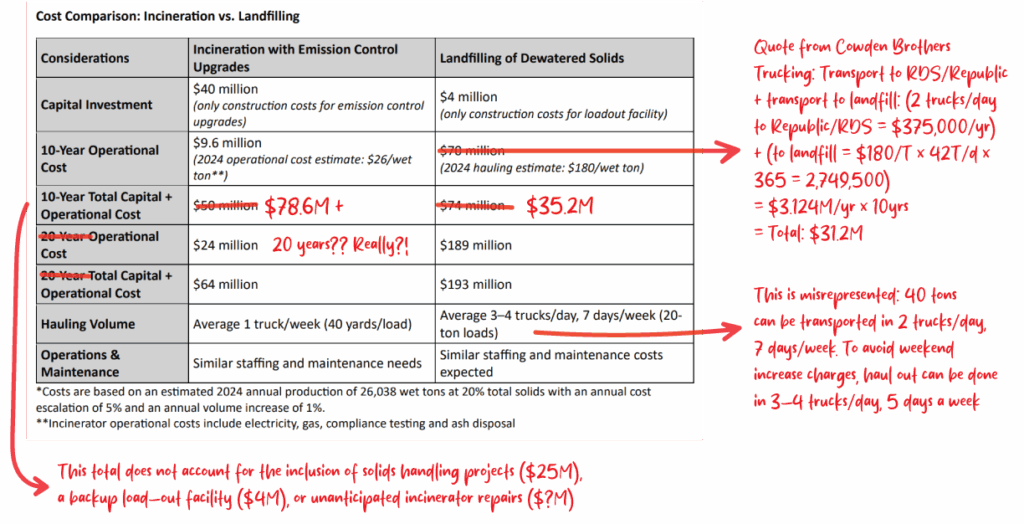
We also recently had the opportunity to hear Mayor Kim Lund address a question about the incinerator upgrade project at the March 18 “Ask us anything,” event. We felt her answer was insufficient and did not address some of the important science-based concerns about the city’s plans for the incinerators. So, we thought this would be a good time to share a few of the themes that have emerged, clarify the common misconceptions we’ve heard, and outline some of our next steps. (You can see a full breakdown of our incinerator vs. landfill analysis here.)
Misconceptions
- The City claims they must upgrade the incinerators because of an agreement with Northwest Clean Air Agency. To avoid fines for violating their clean air permit, the City has planned the $65M emission upgrade project. These upgrades will take about four years to complete. However, shutting down the incinerators would also fix the emission problems—no incinerators, no violations. The City could shut down the incinerators within a year, saving our community three years of pollution, literal tons of natural gas, and a lot of money.
- Landfilling isn’t “just dumping our problems somewhere else,” as we’ve heard some people say. Bellingham sends about 30 truckloads of garbage to Roosevelt Landfill or Columbia Ridge Landfill every day already (both about 400 miles away). Landfilling sewage sludge from Post Point would add an additional two trucks every day. If the City invested in pretreatment technology, such as drying or lime stabilization, the amount of material going to the landfill would decrease and costs could go down.
Cost & Emissions Calculations
- Landfilling will cost about $3.5M/year ($35M for 10 yrs) whereas the incinerator upgrades will cost $65M + $1M/year ($75M for 10 years plus any unanticipated repairs). We could landfill for 20 years and it would be the same cost, with significantly less emissions. But we are not recommending landfilling for 20 years! We believe the City could have an alternative technology in place within 10 years.
- Incinerators burn A LOT of natural gas and emit about five metric tons of GHG every day. Trucking and training this waste would emit 0.53 metric tons of GHG per day. Incinerating produces about 10 times more greenhouse gasses than landfilling. (CO2 equivalency from the EPA’s GHG calculator)
- There is zero energy capture with the incinerators. When landfilling, 50% of the methane is captured and reused, while the other 50% is flared.
Technologies for the Future
- We are not asking the City to invest in risky, nascent technology. Landfilling is more reliable, cheaper, and less polluting. Gasification, which may be a viable alternative, has been around for decades. While its use processing sewage sludge is relatively new, there are multiple, functioning gasifiers in the US and around the world that show this technology is viable. We are asking the city to review alternative technologies and NOT lock us into incineration for 20-plus years.
- The City feels that it is less risky to stick with technology they are comfortable with. We feel it is too risky to rely on technology that is antiquated, more expensive, and very polluting.


Contaminants & Health Concerns
- Sludge contaminants are burned and released in the environment at Post Point every day—365 days a year. Emissions come from natural gas and the burning sludge.
- There are numerous contaminants associated with incinerators. Some of them are regulated, like Cadmium, CO, Hydrogen Chloride, lead, mercury, nitrogen oxides, particulate matter, dioxins and furans, sulfur dioxide. But some of them are unregulated, like PFAS, pharmaceuticals, flame retardants, PCBs, etc.—so we can’t even be sure how much is emitted or how harmful they are to our community.
- Contaminants from a landfill come from fossil fuels used for transporting, contaminants in the sludge are contained in a lined landfill and treated.
- Regulated contaminants associated with Landfills: Particulate matter, nitrogen oxides, CO, CO2, Volatile Organic Compounds, sulfur dioxide.

And finally, we’ve been asked “Why did RE Sources wait until the last minute to do this petition?” The truth is we’ve been working on this issue for seven years. In spring 2025, when the City was notified about its NWCAA violations, we once again asked to meet with the Mayor and Public Works leadership. We’ve written letters to the mayor and City Council, met with the Mayor and her army team, authored op-eds, and talked with reporters—none of which led to a meaningful, open discussion about an alternative path forward.
The bottom line is the City has not done enough to explore less impactful strategies for managing our sewage solids in the short and long term. They have also delayed meaningful progress to the detriment of the community. We are feeling these effects in the air we breathe, the utility costs we pay, and our ability to be a progressive, sustainable community.
This is the first in a three-part series of blogs. Stay tuned for more about human health impacts of incineration and an exploration of alternative technologies.