
Water links us to our neighbor in a way more profound and complex than any other.
—John Thorson, water law expert
As communities in Whatcom and Skagit counties continue to pick up the pieces after December’s devastating floods, we are once again reminded of the power of water. However, this power lies in water’s capacity for destruction as much as it does connection. This region has been physically shaped by water since time immemorial, yet as we navigate the dynamic nature of our watersheds and the ever increasing impacts of climate change, it is drastically shaping our politics, too.
At the same time we are working to recover from the flooding, unusually warm winter weather and precipitation falling as rain rather than snow is melting snowpack in the Cascades. That means conditions are looking likely that we will face another summer of drought in western Washington. Once again, we are being made starkly aware of the challenge of having too much water in the fall and winter months and not enough water in the summer when people, fish, and farms need it most.
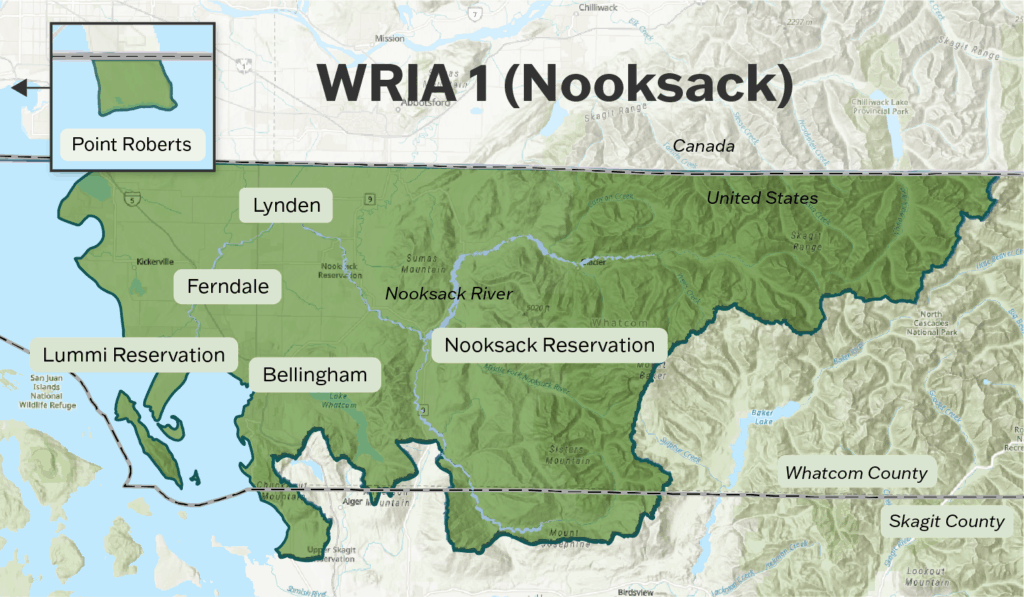
Amid all this change and building pressure, Washington Department of Ecology is initiating an adjudication of ground and surface water rights, through Whatcom County Superior Court, for the Nooksack River, a process that determines who has the legal rights to water and how much. The adjudication process in and of itself is not a silver-bullet solution to our water and climate challenges. However, it is a needed step to a secure future for water access in the Nooksack watershed.
A recap of what adjudication is (and is not):
To protect Tribal treaty rights, struggling salmon, and to maintain access to water for residential, industrial and agricultural uses in increasingly dry summers, we need a thorough review of how water is being used in the Nooksack watershed. Where is water used? Where are these uses legal? Knowing who has rights to how much water is a vital baseline for making choices about this shared resource.
To find these answers, the Washington Department of Ecology (Ecology) is following long-established water laws (1917 for surface water and 1945 for groundwater) to ensure fair management of water use. Adjudication is essential to this undertaking, and can be a time consuming, expensive, complicated legal process in its own right.
It’s also important to remember how we arrived here: neglecting to center the Lummi Nation and Nooksack Indian Tribe and honoring our treaty obligations.
In 2020, after decades of failed attempts at reaching agreements, the Nooksack Indian Tribe and Lummi Nation asked Ecology to step in and initiate a water rights adjudication in the Nooksack watershed. RE Sources supported this request and weighed in in solidarity. Ecology responded to the tribes’ request and initiated the state’s second ever water rights adjudication.
Tribes have the most senior—since time immemorial—water rights in the basin. On that, we all agree and we know they have the largest, most senior piece of the “pie,” but we do not know what that amount is. Given the legacy of colonization and the collapse of traditional lifeways dependent on healthy watersheds, they are the most impacted and harmed water users and that needs to be made more clear in all of these discussions.
When we say it is “time to collaborate,” we need to remember that in order to do so respectfully and effectively we must be honest about how we arrived at this moment, seek out ways to repair past harm, and commit to showing up to these conversations differently.
For a deeper dive into what an adjudication entails you can check our previous blogs on the topic (part 1 & part 2) and the Department of Ecology’s website on the Nooksack watershed adjudication.

Only ~1,600 out of an estimated 15,000+ people have filed water rights claims.
No time to wait or waste:
If we want a smooth process with outcomes that support water security for tribes, farms, fish and people, then there are three things that need to happen as soon as possible—and in parallel.
- Unequivocal support for adjudication: All stakeholders, organizations and governments should come out in full support of the adjudication process and agree to move forward in a way that centers the interests and sovereignty of the Lummi Nation and Nooksack Indian Tribe. Efforts to circumnavigate or stall the process will only exacerbate tension, mistrust, and confusion, which serves only to maintain the status quo of uncertainty and shows a disregard for tribal sovereignty.
- Ensure water users retain their rights: Right now, the priority should be collaboration around a smooth and timely adjudication process. That looks like supporting water users (particularly rural residential and agricultural water users), connecting them to technical resources, and helping them with successfully filing their claim as soon as possible. Because we want them to be able to retain their legal water right—regardless of what solutions we ultimately settle on as a region. As of early 2026, only a small fraction of potential water rights and claims holders have turned in their paperwork, with the May 1 deadline fast approaching. There’s a lot of misunderstanding in the community about what the process is and actually entails—about the questions it can and can’t answer. We encourage those uncertain about their role and responsibilities in the Nooksack adjudication process to see Whatcom County’s pop-up events and workshops and the Department of Ecology’s many resources.
- Invest in watershed solutions: We must act swiftly to address climate change impacts in the Nooksack Watershed through the implementation of natural climate solutions. We do not have to wait to take actions that restore the natural functions of the river. These approaches can often be cheaper and offer a multitude of benefits for numerous problems (floods, drought, salmon recovery…). We know that climate impacts and a growing base of water users will compound the challenges of both flooding and drought. Natural climate solutions are a crucial foundation for rebuilding watershed health and function to buffer the worst of climate change impacts:
- Giving the Nooksack room to roam and bringing wood back into the river are key ways to support this invaluable ecosystem.
- Wetland protection and restoration throughout the watershed helps store and filter water, releasing it slowly into the system throughout the dry months.
- Ecological forest management practices in the uplands of the watershed gets more cool, clean water in the streams and rivers in late summer, reduces fire risk, and can help rebuild and sustain a local timber economy.
Check out our blog on natural climate solutions for a deeper dive into these concepts. Solutions such as water banking and thoughtful water storage infrastructure also merit discussion, while recognizing that we get better bang for our buck by working with nature rather than working against it. Building a solid base through multi-benefit climate solutions allows us to more carefully choose the most cost-effective, appropriate engineered solutions available to fill the remaining gaps.
More on what it means to us to center tribes:
Water conflicts in the west are as old as colonization. There are stories of incredible devastation, but also of inspiration and reconciliation. The Nooksack watershed has, at the core of its water challenges, issues of deep mistrust and historical harm that pervades many of today’s relationships. So much history has not been properly acknowledged or addressed.
This week, on January 22, we honor Treaty Day in Washington state. This day commemorates the signing of the Treaty of Point Elliot in 1855 between the US government and Coast Salish peoples. As we seek solutions and wrestle with anxiety and urgency, it’s important we remember that Lummi Nation and the Nooksack Indian Tribe are sovereign nations, and because treaties with the federal government are the supreme law of the land, they are the senior water rights holders. They signed the treaty to retain the right to fish in their usual and accustomed fishing grounds, not because it was their desired outcome, but because they knew it was their best chance for peace and survival as their people were being colonized, displaced, separated, and attacked.
The Treaty of Point Elliott predates Washington’s statehood—it is our treaty and the responsibility of non-Native folks to uphold. And frankly, in the case of water use in Whatcom County, we are failing to do that. The Tribes have been engaged, in good faith, for decades, and for decades negotiation attempts have failed. If we want different outcomes we must take a different approach.
From in-stream river restoration projects to climate adaptation planning to headwater hydrology studies, these tribes have already invested heavily in solutions for salmon, and for the ecosystems on which their people and their lifeways rely. Prior to adjudication, the Tribes entered into voluntary partnerships to improve water quality and supply, only to see community partners balk at making significant changes.
We believe that stakeholders—including farmers, city governments, Whatcom County, and environmental interests—will start making the kind of progress that is needed when we center the Tribes in the process of finding solutions that benefit all of us who owe everything to the waters that flow through the Nooksack watershed.
Now is the time for the leaders in our community and the governmental and nongovernmental stakeholders who have been engaging in watershed management for decades to decide what we will do differently this time. What will we bring to the existing collaborative spaces that will shift the course of the conversation? What will we do to better understand what is needed to create a new approach that builds trust?
There is a lot of healing to be done before we can make a meaningful attempt to settle or negotiate (again). This process will only move at the speed of trust. But just like the flow of water, the building of trust and connection carries immense power.