
5 Year Stormwater Summary Report
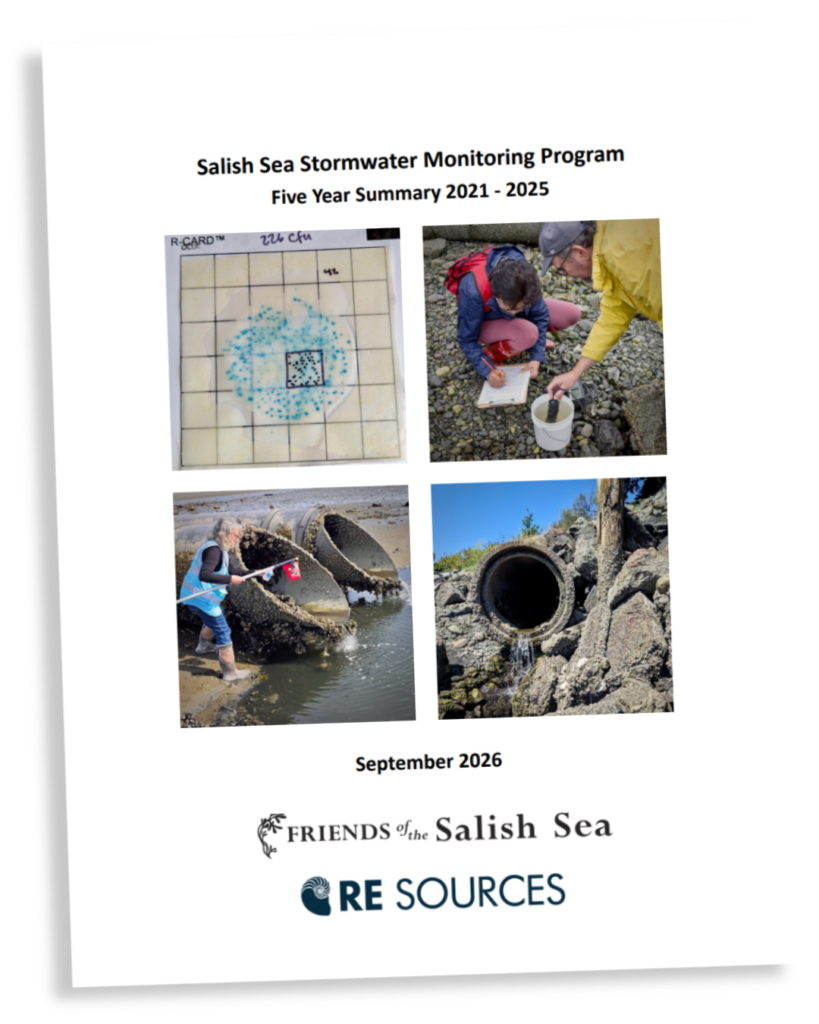
Abstract: Stormwater is the largest source of pollution to the Salish Sea, yet Washington’s Phase II Municipal Stormwater Permits do not require permit holders to monitor the water quality of local discharges. To address this gap, two nonprofit organizations began a community science stormwater monitoring program in Bellingham and Anacortes in 2021. The program has since expanded to include Oak Harbor, Mukilteo, Everett, Edmonds, Shoreline, and Poulsbo. This report summarizes five years of data collected by over 90 trained volunteers at 88 sites (68 stormwater outfalls and 20 urban creek sites) across these eight Salish Sea communities. Monthly monitoring included water temperature, dissolved oxygen, conductivity, salinity, pH, turbidity, and Escherichia coli (E. coli) fecal bacteria, along with observational assessments of flow rate, color, odor, and other visual indicators. Each site received an overall water quality health rating of Good, Watch, or Threat based on the frequency of exceedances of stormwater thresholds (outfalls) or water quality standards (streams). Six sites were rated Good, 47 Watch, and 35 Threat. E. coli was the parameter with the most frequent exceedance rate in five of eight cities, followed by dissolved oxygen and temperature. Elevated conductivity was largely attributable to tidal seawater influence rather than pollution. Monitoring results directly informed several successful pollution source investigations in partnership with stormwater managers, including illicit sewage connections and spills. These findings demonstrate that pollution continues to enter the Salish Sea via stormwater even where permit requirements are met and that without site specific monitoring these pollution sources will continue undetected. The Salish Sea Stormwater Monitoring Program is a successful example of a low-cost, volunteer-based monitoring model that can generate data that supports pollution source tracing, leads to corrective actions, and measurably reduces stormwater pollution while also providing a meaningful opportunity for community engagement.