
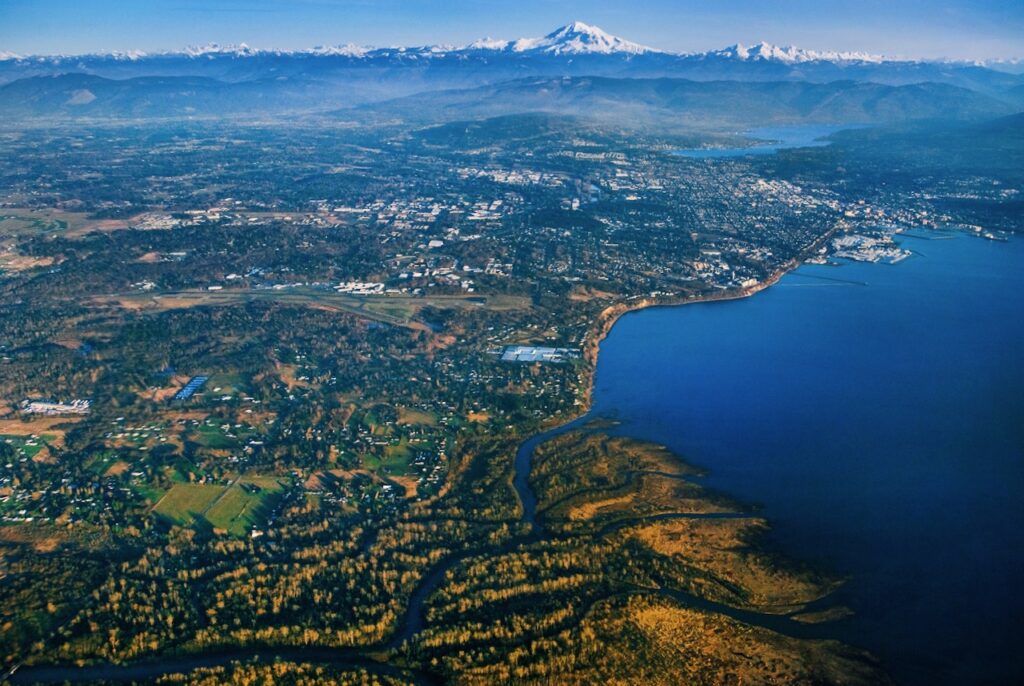
Northwest Washington is a place of unique abundance. Salmon and orcas move through the Salish Sea, one of North America’s largest estuaries, billions of birds pass through along the Pacific Flyway, and our mature forests store carbon as well as almost anywhere on Earth. The same land and water supports agriculture, working forests, and four of the state’s five oil refineries. An expanding population, rising sea levels, flooding, and wildfire smoke—all in a changing climate—add further complexity to choices about how and where to grow.
Whatcom County’s Comprehensive Plan is where those choices get made. It’s the blueprint for the next 20 years: where homes, farms, industry, and open space go, and how we protect water and wildlife along the way. Every zoning code, development regulation, and permit decision that follows has to be consistent with it. That makes the plan the foundation for nearly all of our land use advocacy. When we challenge a risky permit or push for stronger protections, the plan is what we point to. A strong plan with ample community input gives communities firm ground to stand on for decades.
Since the County kicked off this update in 2022, RE Sources’ policy staff have submitted comment letters on individual chapters and the final draft, testified at hearings, and served on County advisory committees. We worked alongside organizational partners including Community to Community Development, Whatcom Environmental Council, and Futurewise to gather community input and hone in on the most important opportunities to strengthen the Plan. After years of work across the community, Whatcom County Council adopted updates to the plan in July.
Community-driven decision making
Comprehensive planning is one of the most important processes in local government — and one of the hardest to take part in. Hearings happen during work hours, drafts run hundreds of pages with short turnaround times before hearings, and the voices in the room usually belong to people and organizations who have the time or the paid staff to track it all.
We believe a critical piece of building resilient communities is a planning process that centers community voices, allowing the experiences and concerns of the people who live here to more directly shape our shared future. This Comp Plan update process offered an opportunity to take small steps toward this. We hosted “Comp Plan 101” presentations explaining what the plan can and can’t do, and hosted hands-on workshops on the recreation and climate chapters. At those workshops, community members read draft language together, talked through what was missing, and wrote their own amendments. RE Sources included our suggested language and ideas in the feedback we shared with the County.
Not every idea made it into the final draft of the Plan as written, but the fingerprint of the climate workshop’s focus on protecting Tribal treaty rights and keeping enough water in our rivers and streams is visible in the final Plan’s water and environment policies. Additionally, a recreation policy that workshop participants drafted will come back during the County’s parks plan update next year.
Through these collaborations, we learned that people want to weigh in on specifics. They want to know their time will make a difference. And traditional public comment spaces can be intimidating, if not inaccessible, to many. We’ll build on these lessons in 2027 with a larger push for community-powered decision making.
Wins for Whatcom
Best available science informs growth decisions. Updated FEMA flood maps and the County’s own sea level rise and flooding models were used to evaluate where growth should go.
Healthy watersheds come first. Alongside the WRIA 1 Planning Unit, we held the line on language around “restoration” and “enhancement of ecosystem function. Projects that maintain or enhance watershed functions, like natural water storage projects, are specifically prioritized over those that degrade existing natural systems and infrastructure.
Cherry Point protections. A late slate of amendments could have undermined the thoughtful, painstaking process that resulted in the 2021 Cherry Point Amendments. At the urging of RE Sources and partners WEC, the Council rejected the amendments and kept the version the Planning Commission had approved.
Tribal sovereignty and equity. The 2016 plan’s Introduction chapter never mentioned Tribal engagement. The new plan begins by recognizing Tribal sovereignty, treaty rights, and self-determination, and it commits the County to working collaboratively with Tribes. It also sets a new goal to work toward eliminating racial and economic disparities. We hope to see these goals reflected in the actions taken to implement the plan over the next decade.
First steps on climate. Under a new state requirement, this is the County’s first comp plan with a climate chapter. It includes support for community-owned clean energy, microgrids and battery storage, and reuse of construction materials.
Where the plan falls short
Planning too much growth in rural areas. We supported the decision to lower the rural population allocation from 10,000 to 9,000 people, but that’s still too high. Rural growth costs more to serve and drives up housing development costs, strains groundwater supply, and means more driving and pollution as residents commute to work and services each day.
Planned growth impacts agricultural lands without making up for lost acres. While the plan does not expand Urban Growth Areas, it does include UGA swaps impacting agricultural lands. The County’s proposed policy for addressing this loss asks developers to compensate the County monetarily, instead of the County finding alternative acres to designate as farmland to physically replace them.
Protection for people already at risk. The plan discourages new development in flood-prone areas, but does little to outline what will be done to protect the people and homes already there.
Water supply should drive development. If water isn’t available, an area shouldn’t be slated for more growth until a water supply solution is found. This isn’t explicit in this plan.
Climate commitments. The plan doesn’t set clear greenhouse gas emissions reduction targets, outline plans for reducing emissions, adopt the County’s Climate Action Plan, or do enough on industrial emissions and building electrification.
What’s next for RE Sources
An Appeal. We are hopeful in the progress made by instituting a new Climate chapter during this round of updates, but we cannot wait another ten years to rectify the climate resiliency gaps that remain. In September, RE Sources and Whatcom Environmental Council, with legal representation from Futurewise, jointly filed an appeal of the Plan with the Growth Management Hearings Board. This appeal addresses, among other issues, the lack of measurable greenhouse gas emissions goals and plans, as well as an unacceptable loss of agricultural land in proposed Urban Growth Areas and Urban Growth Reserves. If successful, this appeal would require the County to address these issues now instead of in a decade during the next scheduled comprehensive plan update.
Critical Areas Ordinance (CAO). Implementing the Plan is arguably just as important as drafting the overarching goals within it. The Critical Areas Ordinance, scheduled to be updated this fall and finalized in December, is our first opportunity to do this. The CAO is a set of development regulations that serves as the foundation of environmental protections in Whatcom County, and the guardrail ensuring that our land-use decisions aren’t further degrading our natural systems’ ability to function. Healthy natural systems are our first line of defense in combatting the worst of climate change impacts on our region. In this update, we’ll be pushing for stronger protective language, a shift toward Net Ecological Gain (NEG) as a planning baseline, and creative ways to ensure that CAO policies allow for compatible efforts to introduce or expand regenerative practices across our landscape.
We remain committed to staying engaged with our partners and supporters to ensure implementation of these policies in order to secure a climate-resilient future for Northwest Washington.
Subscribe to our Action Alerts to be notified of ways to engage in these next steps to make sure your voice is heard!